
When UQ computer science student Matt Gagan listened to his parents discuss a tricky research problem over dinner, he didn’t expect it to help solve a 50,000-year-old mystery - or for it to lead to his contribution to an international scientific paper.
At the time, Matt was an undergraduate studying a Bachelor of Computer Science and Commerce at UQ. Just last week, he officially graduated.

The research he completed as a student has helped scientists better understand the disappearance of Homo floresiensis, the small-bodied hominin known as the “hobbit”, from the Indonesian island of Flores.
Growing up around science
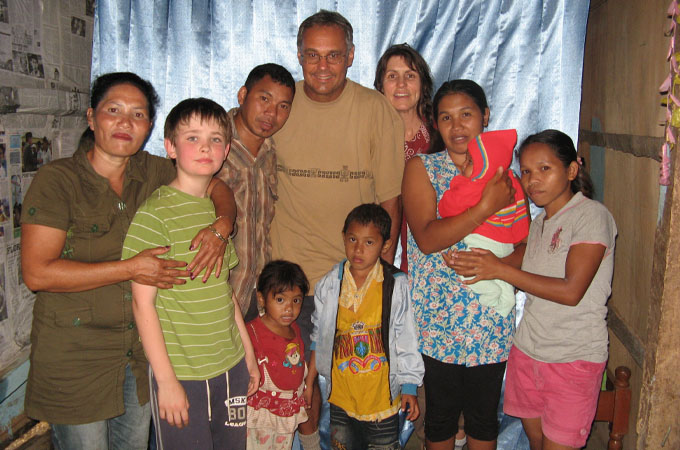
Matt grew up immersed in research. His father, UQ Honorary Professor Mike Gagan, is a palaeoclimatologist, and his mother, Heather Scott-Gagan, is a geologist. The family lived in Indonesia for four years while Matt was growing up, and he visited the Flores cave sites in 2011.

“I always knew about my parents’ work,” Matt says. “But I never thought I’d help solve one of their research questions.”
That changed when the team faced a long-standing challenge: precisely aligning ancient climate records from cave stalagmites with fossil evidence showing when pygmy elephants - and the “hobbits” who hunted them - declined.

A mathematical solution
To Matt, the problem looked familiar.
“When Dad explained the problem, I saw how I could use the mathematical and computer science skills I’d learned at UQ to help solve it,” he says.
Using skills developed through his UQ courses, including linear algebra and discrete mathematics, Matt designed a series of equations that identified statistically meaningful matches between climate signals preserved in stalagmites and those recorded in fossil tooth enamel.
The result was a much more precise timeline linking prolonged drought on Flores to ecological decline.
Real impact
The research shows that intensifying drought from around 61,000 years ago reduced freshwater availability, contributing to the loss of pygmy elephants and the gradual abandonment of the Liang Bua cave site by Homo floresiensis.
“Understanding how these climate systems behaved in the past helps us understand how ecosystems respond to change today,” says Mike Gagan.
The power of undergraduate training
Matt’s contribution highlights the value of UQ’s undergraduate education in developing adaptable problem-solvers.
“If you’re taught how to problem-solve, you can apply those skills anywhere. Look for opportunities to get connected to research - it can open doors you never expected.”
Having completed this research as an undergraduate and graduating just last week, Matt is now exploring his next steps, including the possibility of starting a business before pursuing a career in computer programming. Future collaborations with his parents are not off the table.
“It’s a definite maybe,” Matt says. “You never know what interesting questions might pop up over dinner in our house.”
If you’re interested in diving deeper into the study, you can read the full research in Communications Earth & Environment.
Discover what UQ's Bachelor of Computer Science covers and how it equips students like Matt to tackle complex problems.


